Which numbers can we trust?
Understand what your marketing, CRM and sales reports measure, where definitions differ, and which figures are reliable enough to inform decisions.
Your advertising dashboard reports leads. Your CRM reports customers. But when it's time to decide which marketing channels deserve more budget, do the numbers actually agree?
In three weeks, I'll examine your lead-to-customer journey, test a defined sample of records where the data allows, identify where reporting becomes unreliable, and prioritize the fixes that matter most.
You'll leave knowing which numbers you can trust, where visibility breaks down, and what needs to change before you make your next marketing investment decision.
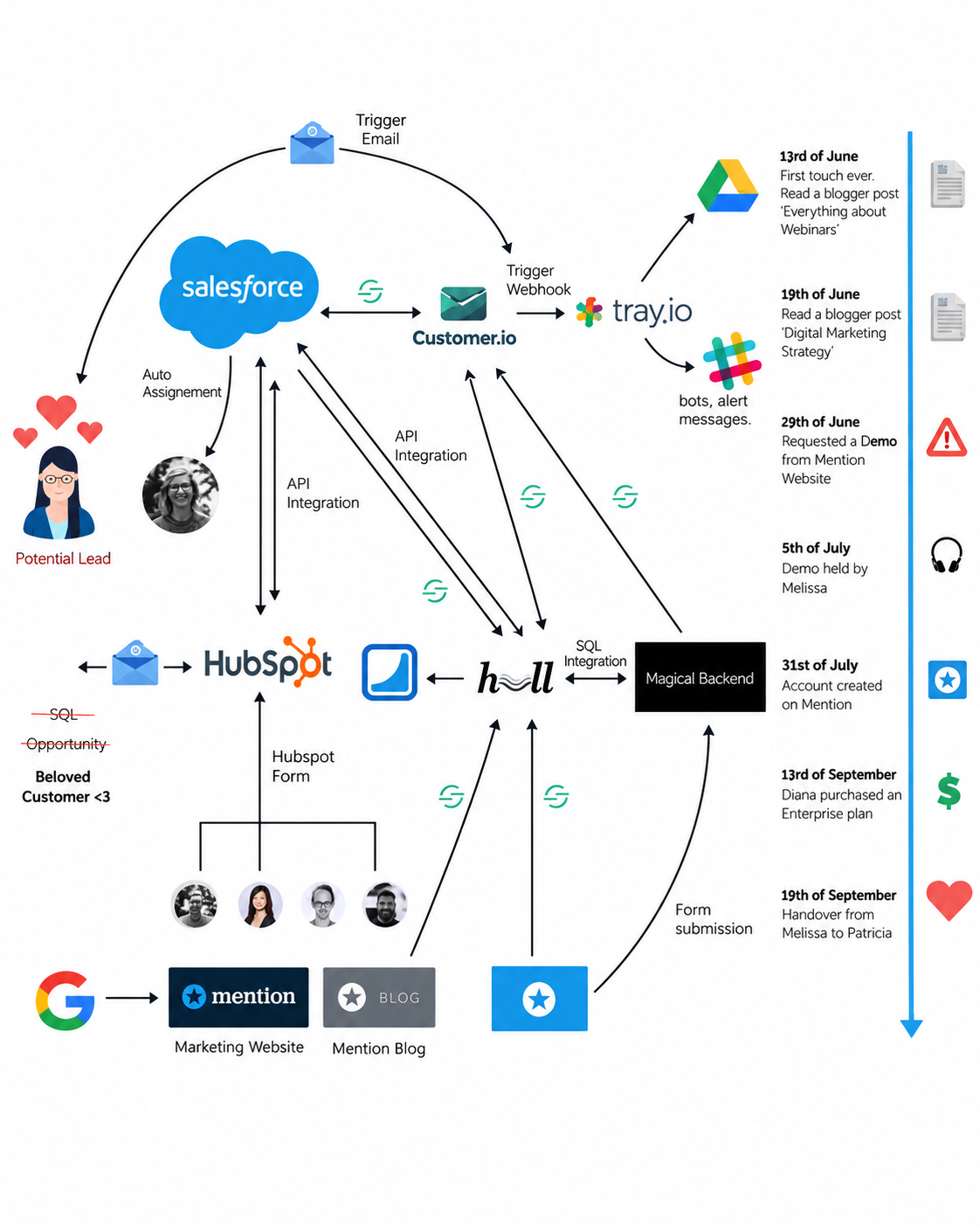
Your campaigns are running. Leads are coming in. Your marketing team has reports showing impressions, clicks, enquiries and conversions.
But the commercial question is what happens after someone becomes a lead.
How many turn into qualified opportunities? How many become paying customers? And which marketing activities contributed to those outcomes?
Perhaps your advertising platform reports one number, your CRM another, and your sales team something entirely different.
Or perhaps a campaign appears expensive based on cost per lead, but nobody can establish whether those leads became valuable customers.
The problem isn't necessarily that anyone's report is wrong.
It's that the reports may not tell you enough about what's happening between marketing activity and commercial results.

When you can't confidently connect marketing activity to customer outcomes, it becomes harder to decide where your next marketing dollar should go.
A lead recorded in an advertising platform isn't necessarily a unique prospective customer. A customer recorded in your CRM doesn't necessarily retain the source of their original enquiry. Different systems measure different things. That's normal. The problem begins when those differences aren't understood or important information disappears between systems.
Understand what your marketing, CRM and sales reports measure, where definitions differ, and which figures are reliable enough to inform decisions.
Examine where information may be lost, duplicated, overwritten or disconnected as prospects move through your business.
Distinguish verified marketing and customer relationships from assumptions, estimates and outcomes that existing records cannot establish.
Identify the reporting, tracking and workflow improvements that matter most, with a prioritized plan for addressing them.
The objective isn't to make every report show the same number. It's to understand what those numbers mean and how confidently they can guide investment decisions.
I'll review the agreed advertising platforms, analytics setup, conversion definitions and current reporting. I'll examine whether the figures being compared represent the same stages of the customer journey and where limitations affect their interpretation.
I'll map how a prospective customer moves from initial enquiry through qualification, sales activity and recorded commercial outcomes. This includes how records enter systems, how teams update them and where information passes between tools.
Where suitable data and authorized access are available, I'll examine up to 25 leads to investigate specific reporting questions. This may include missing source information, historical changes, duplicate records and inconsistent customer statuses.
I'll assess potential improvements to tracking, CRM workflows, conversion definitions, reporting processes and integrations. Recommendations will distinguish operational changes from technical work requiring specialist review or implementation.
I'll assess issues by commercial significance, dependencies, feasibility and their relevance to the decisions leadership needs to make. The result is a prioritized improvement direction, not an unlimited technical audit.
The sprint translates reporting uncertainty into documented findings, evidence limitations and prioritized operational and technical requirements.
A documented view of how marketing activity, lead records, sales stages and customer outcomes are currently captured and reported.
An examination of customer handoffs, workflow limitations and sample-level findings where validation is feasible.
A prioritized record of discrepancies, missing information, inconsistent definitions and reporting limitations.
Recommendations for tracking, CRM processes, source preservation, reporting, data quality and relevant integration considerations.
Recommended actions, priorities, responsibilities, dependencies, milestones and measures of progress.
We'll review the findings in a final leadership walkthrough, distinguishing what the evidence reliably establishes, what is inferred, and what your business cannot currently measure. You won't simply receive a list of reporting problems. You'll receive a clearer basis for making decisions and improving the information behind them.
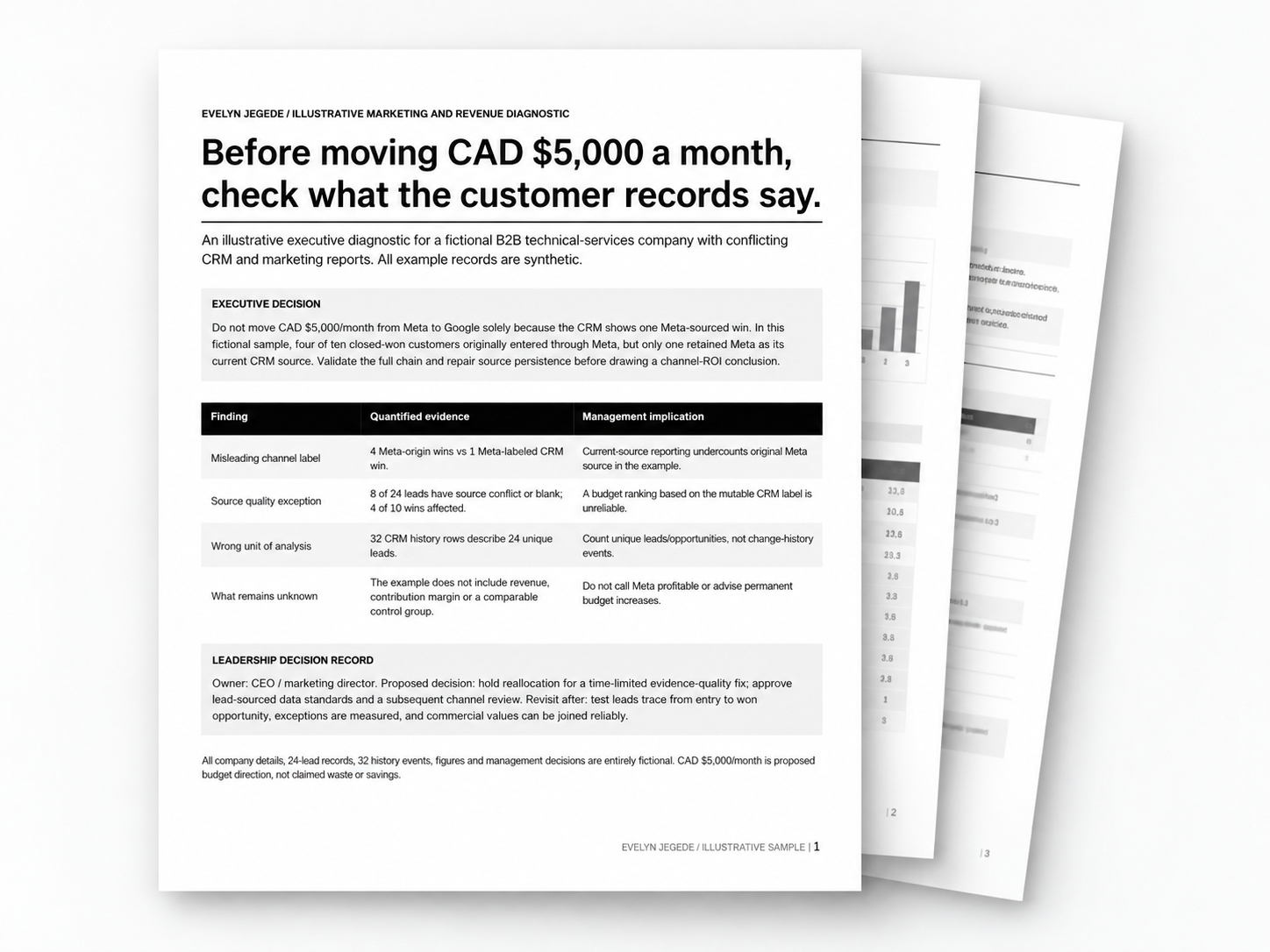
You shouldn't have to commit to consulting without understanding the type of investigation and recommendations you're paying for.
I've developed a sample using a fully synthetic dataset containing 24 unique leads, 32 historical CRM events and ten recorded wins.
Of those ten wins, four had earlier Meta lead records, but only one was labelled Meta in the current source field.
Looking only at the latest CRM source produces a different picture from examining historical records.
The sample demonstrates record-level reasoning, evidence classification, reporting-gap diagnosis and prioritized recommendations.
Illustrative consulting deliverable using fictional records. Not a completed client engagement.
My approach combines commercial diagnosis, customer journey analysis, reporting requirements and coordination of technical work.
In a multi-location swim school business, marketing leads and customer enrollment information existed across different systems.
Advertising activity could be measured and enrollments recorded, but connecting those events over time required examining how information moved between marketing and sales systems.
I led the approach to connecting records across Salesforce, Nimbata and reporting infrastructure through BigQuery, coordinating with technical specialists and overseeing reconciliation and quality assurance.
The work identified approximately 460 enrolled families with earlier Meta lead records. Those historical connections mattered because a customer's current CRM source did not necessarily preserve an earlier marketing interaction.
A recorded connection doesn't independently prove that advertising caused an enrollment. It provides additional evidence for interpreting marketing's relationship to customer outcomes.
Read the case study ↗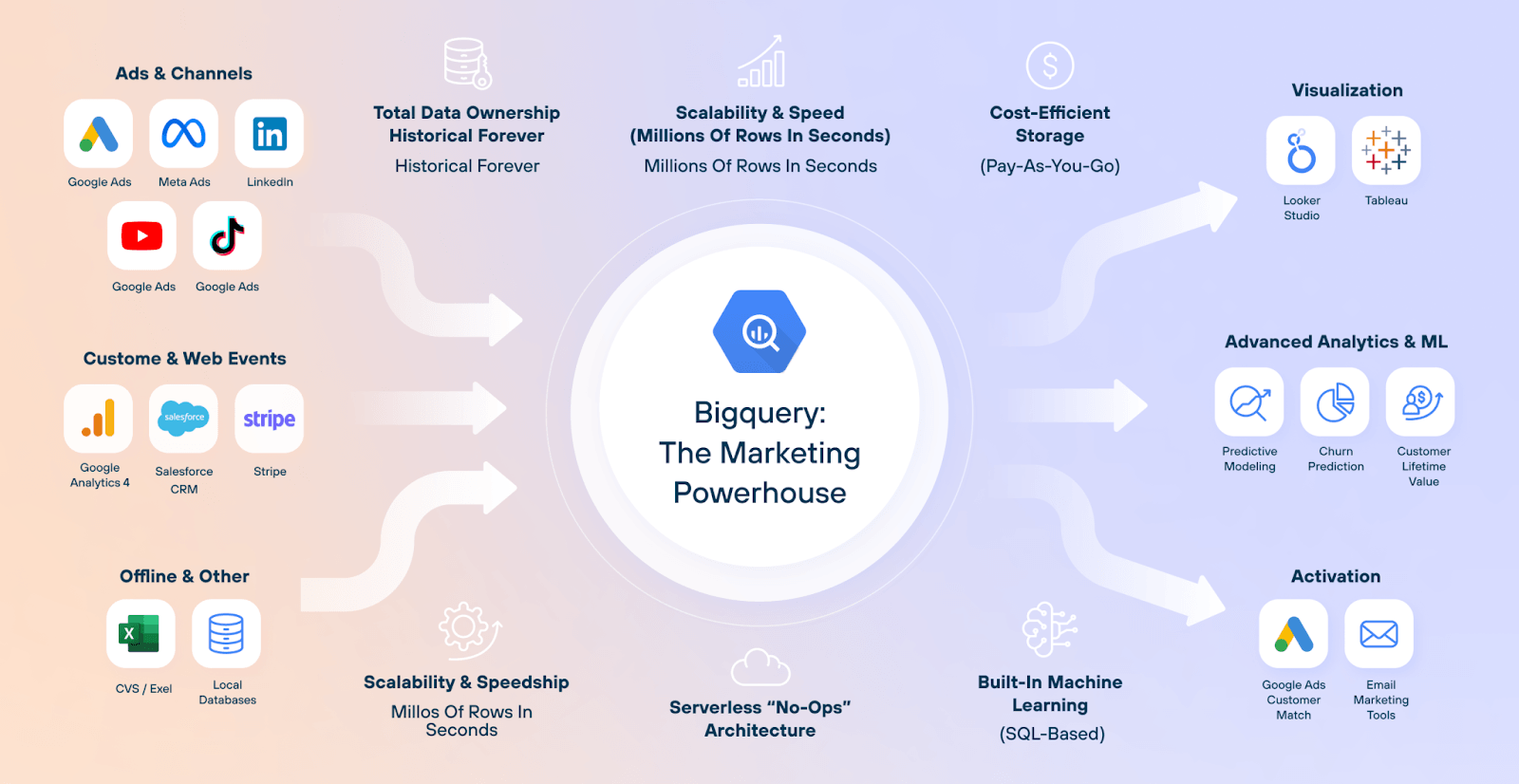
Measurement challenges aren't always confined to one advertising account or tracking tag. They can involve customer records, sales processes, integrations, conversion definitions and the decisions made by different teams. My work focuses on connecting those pieces to the underlying commercial question.
If you have an internal analytics, CRM, marketing operations or technical team, they'll receive documented requirements and a prioritized roadmap they can use to make improvements.
If you don't have the people or technical resources available, I can also help coordinate and oversee implementation through trusted independent specialists.
Depending on the findings, that could involve improving conversion tracking, preserving lead-source information, updating CRM workflows, connecting systems or developing more useful reporting.
My role is to keep the work connected to the commercial objective, coordinate agreed activities and provide strategic oversight. Specialist technical work would be handled by appropriately qualified delivery resources.
You can use the roadmap with your existing team, work with your own technical partners or discuss coordinated implementation support with me.

We'll establish your reporting challenge, commercial objectives, conversion definitions and agreed system coverage.
I'll review available information, map the lead journey and determine which discrepancies need closer examination.
Outcome: current-state measurement map and investigation priorities.I'll examine relevant reporting, lead handoffs and tracking processes, including bounded sample validation where feasible.
I'll document the evidence, gaps, limitations and technical requirements, with specialist feasibility input where needed.
Outcome: measurement-gap findings and proposed requirements.I'll bring the findings together into a written diagnostic, prioritized technical and operational recommendations, and a 90-day improvement roadmap.
We'll review the findings and recommendations together in a leadership walkthrough.
Outcome: diagnostic package, roadmap and leadership walkthrough.Includes one kickoff, up to two stakeholder discussions, limited technical feasibility review, one final leadership walkthrough and one consolidated revision. The three-week period starts after kickoff and receipt of the agreed information and authorized access.
Three-week pilot engagement.
One business unit and one primary customer journey, within a defined measurement environment.
Established B2B and service businesses already investing in marketing and recording enquiries, opportunities or customer outcomes.
Particularly relevant for businesses with conflicting reports, incomplete lead-source information, rising acquisition spending or uncertainty about marketing's commercial contribution.
Building dashboards, deploying tracking changes, CRM configuration, system integrations, historical data reconstruction, custom attribution modeling and ongoing reporting management are not included.
The sprint does not guarantee perfect attribution or recover information that was never captured. Any technical implementation requires a separate agreement.
Different totals don't automatically mean something is broken. Systems may measure different events, use different definitions or record different customer journey stages. I'll investigate whether those differences are understood and where information may be missing or misinterpreted.
You don't need to identify the technical cause before the engagement. We'll begin with the business questions and reporting discrepancies that matter, then assess the agreed systems and available evidence.
Only to the extent that existing records and measurement methods support that conclusion. Some journeys can be linked to earlier marketing interactions. Others may contain missing, overwritten or incomplete information. Connecting records also doesn't automatically prove a campaign caused a sale.
The fixed-fee sprint covers one business unit, one primary customer journey, one CRM, one analytics setup and up to two paid platforms. For more complex environments, we can agree on the highest-priority area or discuss a different scope.
If the issue is already known and requires one straightforward technical fix, hiring a qualified technician directly may be a better investment. This sprint is for broader reporting, workflow or system uncertainty where the first challenge is identifying what needs fixing.
No dedicated internal technical team is required for the assessment. Your business will need someone who can provide approved access to the agreed systems and records. The roadmap can then be implemented by your existing team, your own technical partner or specialists engaged separately.
The sprint covers investigation, diagnosis, recommendations and implementation planning. Live technical changes are not included in the fee. This allows the business to understand what needs attention before committing to implementation.
Incomplete data may itself be an important finding. I'll distinguish what the records establish from what remains uncertain and recommend improvements to future data capture or reporting processes.
Yes. We can discuss separately scoped implementation coordination or continuing strategic oversight, depending on the recommendations and your business's needs.
You're already investing in attracting customers. Before increasing budgets, changing agencies, cutting campaigns or expanding into new channels, it makes sense to understand what your current evidence can actually tell you.
You don't necessarily need another dashboard. You need to know which information is reliable, where connections are missing and what improvements will make your next decision better informed.
If your marketing, CRM and sales numbers tell different stories, let's discuss the business question you're trying to answer.
Tell me where your marketing, CRM and sales numbers stop making sense. We can discuss whether a focused diagnostic is the right next step.