Who should we pursue?
Compare buyer segments based on purchasing needs, commercial attractiveness, market signals and fit with what your business sells.
When growth depends on the same customers and referrals, the answer isn't always more prospecting. It may be knowing which customers represent your strongest next opportunity.
In three weeks, I'll assess your market, compare potential buyer segments, examine your competitive position, and identify where your business has the strongest opportunity to win.
You'll leave knowing who to prioritize, why they might choose you, how to reach them, and what your team should focus on over the next 90 days.
You've built a business with a product or service customers already buy. But finding the next source of growth isn't always straightforward.
Perhaps most of your revenue still comes from existing accounts and referrals. Perhaps you're considering a new industry or customer segment without knowing whether the opportunity justifies the investment.
Or perhaps your sales team is actively prospecting, yet there's no clear agreement on which types of customers deserve the most attention.
The instinctive response is often to generate more leads, expand outreach or invest in another marketing channel. But more activity doesn't necessarily answer whether you're pursuing the customers your business is best positioned to win.
Not every potential customer represents the same commercial opportunity. One sector may have strong demand but intense competition. Another may be smaller, yet better aligned with your capabilities. Your strategy should identify more than who could buy. It should help establish who's worth prioritizing.

Compare buyer segments based on purchasing needs, commercial attractiveness, market signals and fit with what your business sells.
Identify how your business compares with competitors and which strengths deserve greater emphasis.
Determine which messages and customer acquisition approaches make sense for the buyers you want to attract.
Translate the research into a prioritized 90-day plan for your sales and marketing efforts.
The goal isn't to create more activity for your business. It's to make that activity more commercially intentional.
I'll review how your business currently wins customers, including positioning, website messaging, relevant sales materials, acquisition channels and the journey from interest to enquiry. Where available, I'll examine information your team provides about current performance.
I'll research and compare up to two buyer segments within the agreed market, considering purchasing motivations, business needs, market signals and suitability for your offering.
I'll assess up to five relevant competitors, looking at how they position their offerings, communicate value and visibly approach customer acquisition. This helps identify where your business has a credible reason to win.
I'll recommend which buyers deserve priority, how your offering should be positioned and up to two acquisition approaches worth pursuing, taking account of your objectives and available resources.
A research-backed growth strategy with explicit choices and a practical 90-day plan for what happens next.
A comparison of selected buyer segments, their needs, purchasing considerations, market signals and attractiveness to your business.
An evaluation of up to five competitors and where your business can communicate its value more effectively.
Findings from your existing messaging, acquisition channels, relevant sales materials and enquiry journey.
Recommended buyer priorities, positioning direction and up to two acquisition approaches supported by the research.
Sequenced actions, suggested owners, timing, success measures and assumptions your business should monitor.
We'll review the assessment together in a final leadership walkthrough, so you understand not only what I'm recommending, but why.
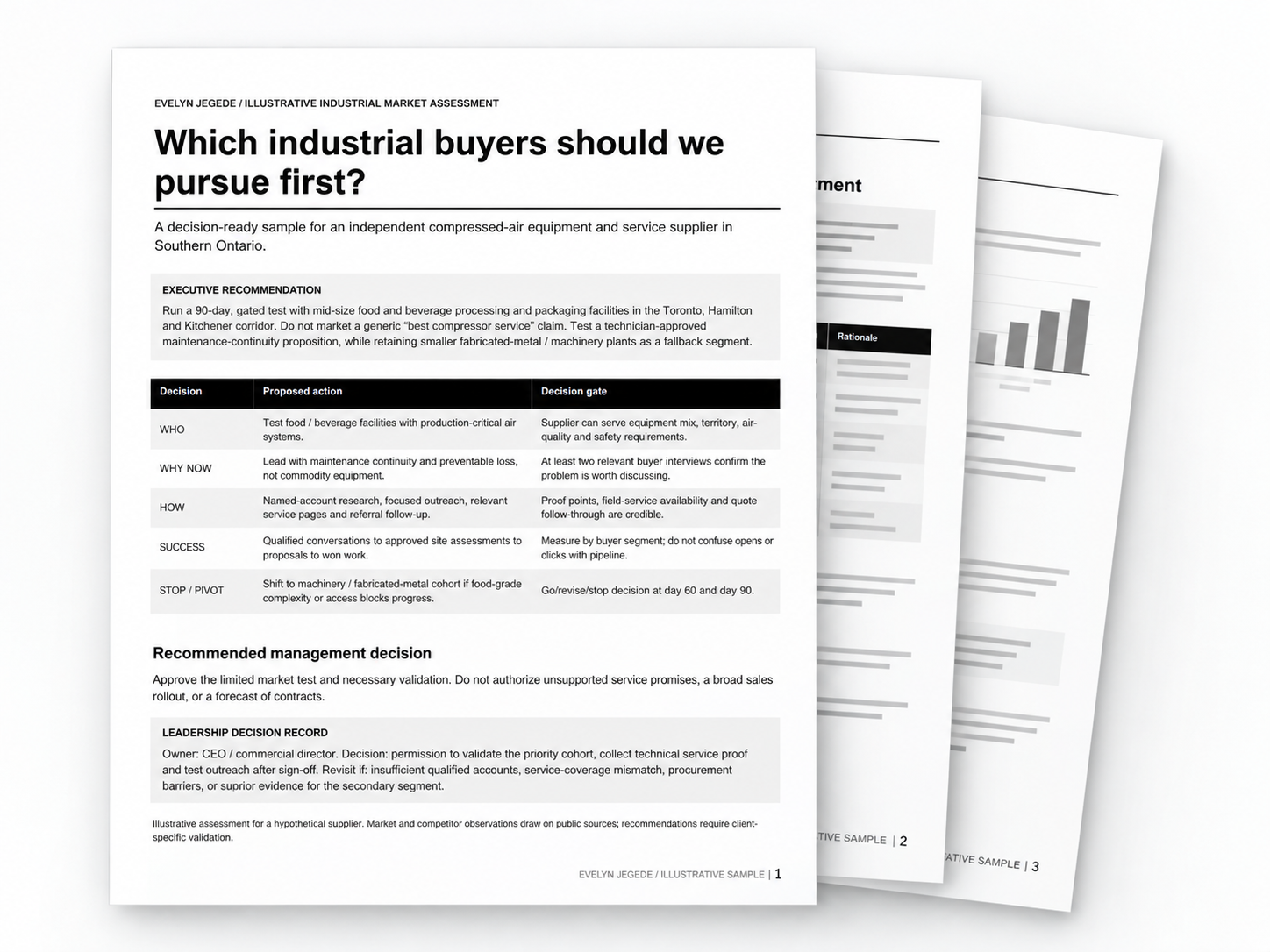
You shouldn't have to guess what you're paying a consultant to produce.
This sample considers an independent industrial compressed-air supplier exploring growth in Southern Ontario. It demonstrates buyer-segment comparison, competitive positioning, qualification considerations and a prioritized 90-day acquisition plan.
The example uses real public industry and competitor research to illustrate the approach.
Illustrative consulting deliverable. Not a completed client engagement.
My recommendations are informed by experience identifying buyers, developing propositions and translating acquisition strategy into commercial activity.
From 36 qualified commercial prospects, nine sponsorship agreements were secured. I personally led six, from prospect identification and outreach through commercial discussions and completion.
The work involved assessing commercial fit, developing relevant partnership propositions and engaging decision-makers.
Read case study ↗
At Belgian recruitment software company sympl, I worked on buyer messaging, content-led demand generation and nurturing activities connecting prospective buyers with sales conversations.
Across six months, reported lead volume increased by 16% and scheduled sales pitches increased by 12.8%.
Read case study ↗These projects reflect previous B2B commercial acquisition experience; they are not presented as past purchases of this specific three-week sprint.
If you already have a team, they'll receive a clear plan they can execute internally or with existing partners.
If you don't have the people or resources available, I can also coordinate and oversee separately agreed implementation activities, working with trusted independent specialists where additional expertise or capacity is needed.
Depending on the recommendations, that might involve acquisition campaigns, outreach processes, sales and marketing materials or other defined activities required to reach the prioritized buyers.
Your business will still need an appropriate person or separately arranged sales resource to handle sales conversations, proposals and closing decisions.

We'll define your growth objectives, review your offering and existing customers, and assess relevant sales and marketing information. I'll establish the questions the research must answer.
Outcome: a defined decision and research priorities.I'll compare the selected buyer segments, examine competitors, evaluate your positioning and assess the acquisition opportunities supported by available evidence.
Outcome: evidence-informed options and draft recommendations.I'll bring the findings together into your acquisition strategy and 90-day roadmap, then walk your leadership team through the priorities, owners and measures.
Outcome: written strategy, roadmap and leadership walkthrough.Includes one kickoff, up to two stakeholder discussions, one final strategy walkthrough and one consolidated revision. The three-week timeline starts after kickoff and receipt of the agreed information.
Three-week pilot engagement.
One product or service line. One geographic market. Up to two buyer segments. Up to five competitors.
Established B2B manufacturers, industrial suppliers, distributors and specialist service businesses with a viable offering and capacity to pursue new customers, whether through an internal team, founder-led selling or resources they intend to put in place.
Active prospecting, outreach or advertising execution, guaranteed leads, CRM or website development, extensive export or regulatory studies, and implementing the roadmap. Any further work requires a separate agreement.
That's often where the engagement is most useful. The sprint helps leadership decide which buyers, messages and acquisition opportunities deserve priority so existing resources can be directed more deliberately.
You can still benefit if your business has the capacity and intention to pursue customers. The roadmap clarifies the activities and capabilities required. I can discuss separately scoped implementation support with trusted specialists, but someone must still take ownership of sales conversations, proposals and closing decisions.
I'll assess one agreed geographic target market and up to two buyer segments. This can inform commercial attractiveness and positioning, but it isn't an exhaustive market-entry, regulatory or export-feasibility study.
That's a useful finding. The objective isn't to validate an assumption regardless of the evidence. Knowing where not to invest can be as valuable as identifying a promising opportunity.
The sprint is a research and strategy engagement, not a live lead-generation campaign. It doesn't guarantee a specific lead volume, new customers or revenue. Those outcomes depend on implementation, market conditions and the sales process.
Yes. We can discuss an optional, separately priced engagement to coordinate implementation or provide strategic oversight, based on the work required and the resources available.
You don't need to pursue every possible buyer to grow. You need to understand which opportunities are worth pursuing, why those buyers would choose your business, and where to focus next.
Whether you're relying on referrals, considering a new market or questioning your current sales priorities, let's start with the business decision you're trying to make.
Tell me which customer acquisition decision you're trying to make. We can discuss whether the sprint is the right fit.