EARLIEST RECORDED SOURCE
4
Of the ten closed-won records originally entered through Meta.
In this fictional business scenario, leadership is considering moving CAD $5,000 per month away from Meta because the current-source report makes it look weak. Before making that decision, what should the underlying customer records tell us?
Unique synthetic leads examined
Historical CRM status-event rows
Recorded closed-won opportunities in the sample
Imagine a fictional B2B technical-services company comparing Meta lead reporting with its current CRM customer-source report.
The CRM shows only one Meta-labelled win. A leadership team could interpret that as evidence that Meta contributes little to sales and propose reallocating CAD $5,000 per month to Google.
But a CRM's latest recorded source may reflect later customer interactions rather than the earliest known enquiry. The label must be understood before it is used to compare investment.
The first decision is whether the evidence is fit for the budget question—not which channel should win.
Of the ten closed-won records originally entered through Meta.
Of the ten closed-won records currently has Meta as its CRM source.
Three originally Meta-sourced wins now show Google or Direct as the current label. One originally Google-sourced win has a blank current-source field. These are observations within a fictional sample, not findings about an actual company's attribution.
Eight of the 24 leads have conflicting or missing source information. Four of the ten wins are affected. Preserve earliest known source separately from later interactions.
The 32 status-history events represent just 24 unique lead IDs. Counting every event as a new lead would inflate the total.
Enquiries, qualified leads, opportunities and closed sales need agreed definitions and reliable IDs. One account may have more than one opportunity.
The fictional example doesn't include customer revenue, contribution margin or a validated finance-to-opportunity join. A channel-profitability conclusion is therefore unsupported.
Capture original source, campaign information and a stable enquiry identifier.
Retain original source, store latest interactions separately and record stage progression.
Link a distinct opportunity to the accepted sale without double-counting status events.
Present verified metrics, unknown values and exceptions under agreed definitions.
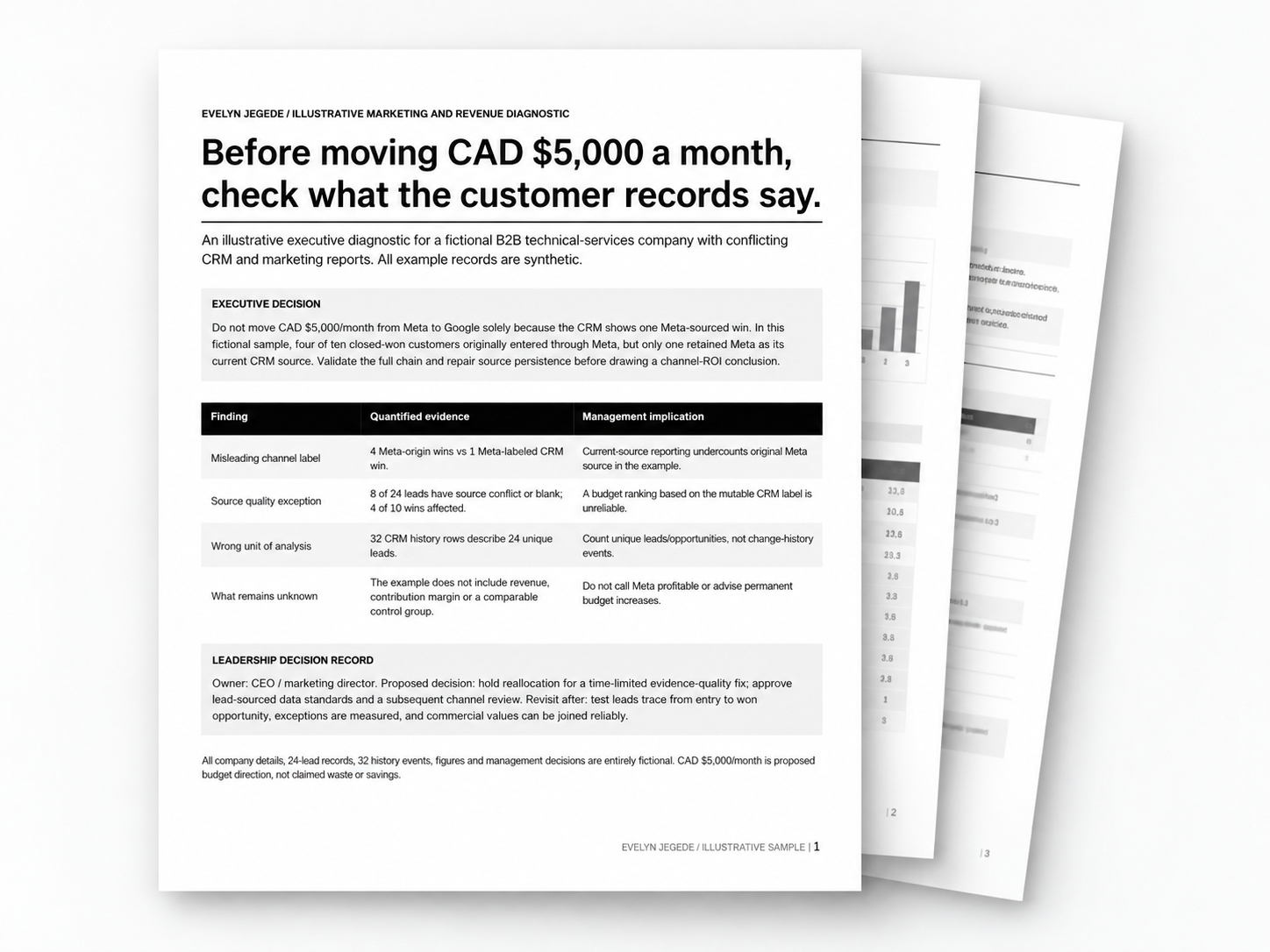
The proposed decision in the fictional scenario is to hold the reallocation temporarily, approve clearer source-data standards, validate the customer journey and then revisit the channel decision using more reliable commercial evidence.
The data supports a finding about record mismatch and reporting quality. It does not establish Meta profitability, causal attribution, incremental sales or the correct budget split.
The CAD $5,000 per month figure is a fictional proposed budget reallocation—not an identified saving, loss or real client budget.Agree definitions, exceptions, privacy requirements and the highest-priority technical changes.
Have authorized specialists establish persistent source capture and test controlled lead journeys.
Validate opportunity identifiers, sales-stage rules and the feasibility of reconciling commercial records.
Monitor completeness and exceptions, then make a qualified investment decision using approved reporting.
The corresponding consulting sprint investigates the agreed customer journey, examines a bounded sample of up to 25 unique leads where lawful access and identifiers permit, identifies reporting exceptions and documents recommended improvements.
The handover is an executive diagnosis, gap register, logical technical and process requirements, acceptance tests and a 90-day plan—not a completed CRM implementation or a rebuilt attribution platform.
Technical feasibility and effort require specialist review. If records cannot support a reliable conclusion, the outcome is a documented limitation rather than an invented answer.
The Marketing-to-Revenue Clarity Sprint helps establish what your reporting actually supports, where visibility breaks down and what needs to change before your next investment decision.