PROPOSED FIRST TEST
3.95/5
Food & beverage
Potentially compelling maintenance-continuity needs and repeat service opportunities, subject to technical and procurement-fit validation.
An independent industrial compressed-air supplier wants to grow in Southern Ontario. Which buyers should it prioritize, what would make them consider switching, and how should a limited sales team test that opportunity?
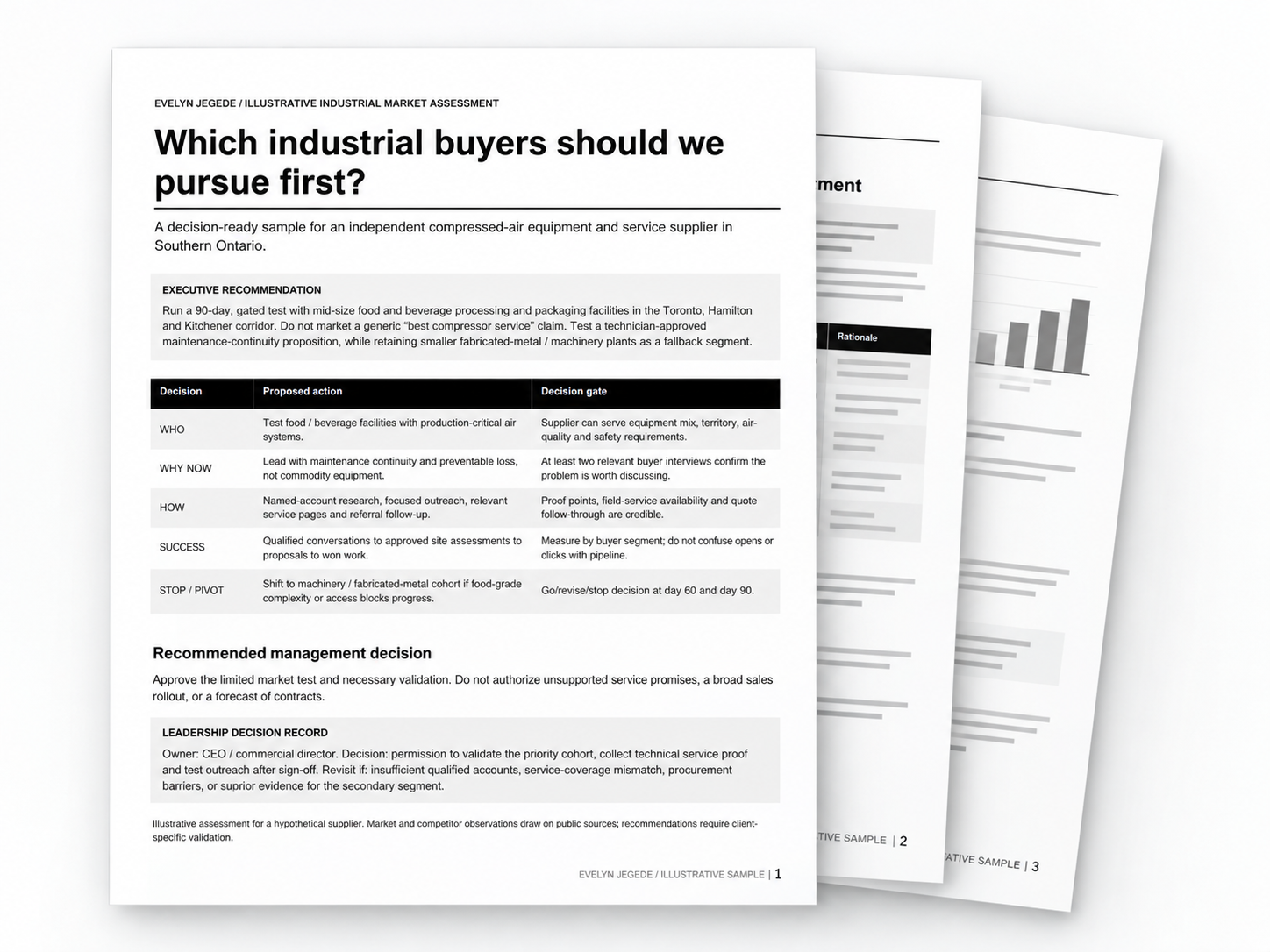
The answer isn't simply the industry with the most factories.
The supplier must be able to reach relevant buyers, service their equipment, respond within its actual operating capacity and make a credible commercial promise.
For this sample, I compared mid-sized food and beverage processing or packaging facilities with smaller fabricated-metal and machinery operations.
The purpose is to show how a buyer opportunity becomes a decision with evidence requirements—not a broad marketing wish list.
Read the full research and assessment PDF ↗These are indicative weighted scores based on assumptions and public evidence—not statistically measured market attractiveness or validated sales potential.
Potentially compelling maintenance-continuity needs and repeat service opportunities, subject to technical and procurement-fit validation.
A credible fallback if food-sector complexity, access or provider capabilities weaken the primary opportunity.
The 0.25-point difference is modest. It's a reason to validate the first hypothesis, not declare a guaranteed winner.
Established suppliers such as Comairco, Atlas Copco, Kaeser, Air Solutions Canada and Barton Air publicly promote service, repairs, audits or related support.
That means “we service compressors” is not a sufficiently distinctive reason for a buyer to change providers.
A more useful initial conversation may focus on documenting production-related maintenance risks and helping the plant decide what deserves technical attention first.
But the promise must be substantiated. Response times, compatibility, technical certifications and food-related requirements cannot be claimed without checking the supplier's actual capabilities.
Selected public sources: Natural Resources Canada, Ontario food manufacturing profile. Full competitor references and limitations are provided in the PDF.
Can the supplier service the specific equipment, certifications, air-quality and safety requirements?
Is there a plausible reason for change—an expansion, repeated outage, contract renewal or maintenance issue?
Can the team identify a relevant maintenance, operations, engineering or purchasing stakeholder?
Can the team respond, quote and deliver profitably within its actual territory and staffing limits?
Screen approximately 25 accounts, confirm service capabilities, gather approved proof points, seek two relevant buyer interviews and establish a suitable enquiry-to-quote path.
Conduct focused outreach and follow-up. Evaluate qualified conversations, site-assessment interest and buyer objections—not just clicks or email opens.
Review proposals, delivery capacity and commercial pipeline. Continue, refine, stop or switch to the secondary segment based on what was learned.
The proposed leadership decision is to authorize a narrow segment test, subject to buyer validation and technical approval. The three-week consulting engagement defines the work; the subsequent 90-day execution belongs to the client or separately engaged implementers.
This sample describes a hypothetical supplier and does not establish that any named facility is a qualified lead, that a particular supplier can meet the technical requirements or that future contracts will be won.The three-week B2B Pipeline Growth Sprint examines your own market, capabilities, target buyers and competitive position to establish a defensible acquisition direction.