Investigate
Start with the business question, understand the context and examine the available information.
Anyone can promise research, insights and recommendations. But what does that actually look like?
I've developed two illustrative assessments to demonstrate how I investigate business challenges, evaluate evidence and turn findings into commercial priorities.
Explore the research, reasoning and recommendations behind each example.
See the analytical work behind the recommendations before deciding whether to work together.
ABOUT THESE EXAMPLES: These assessments were independently developed to illustrate my consulting approach. The industrial assessment uses a hypothetical business and public industry research. The marketing diagnostic uses synthetic records. Neither is presented as a completed client engagement.
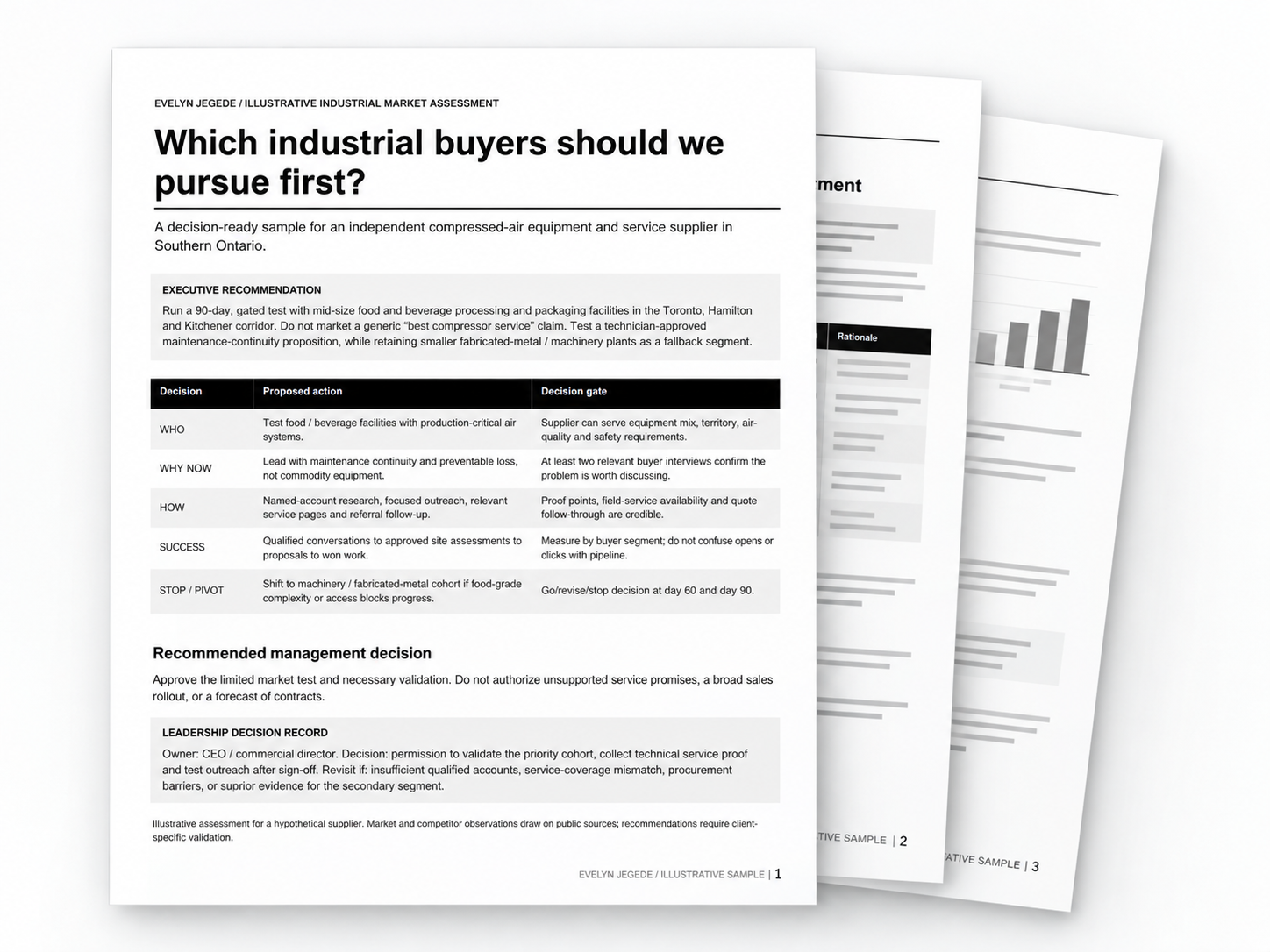
Imagine an independent industrial compressed-air supplier looking to grow in Southern Ontario.
Several industries could potentially need its services. But which buyer segments represent the strongest commercial opportunity? How competitive are those markets? And where should the business concentrate its sales efforts?
This illustrative assessment examines those questions through buyer-segment research, competitive positioning and commercial prioritization.
Comparing potential buyer segments for commercial attractiveness and fit.
Using public industry and competitor research to inform positioning decisions.
Translating the findings into acquisition priorities and a practical 90-day plan.
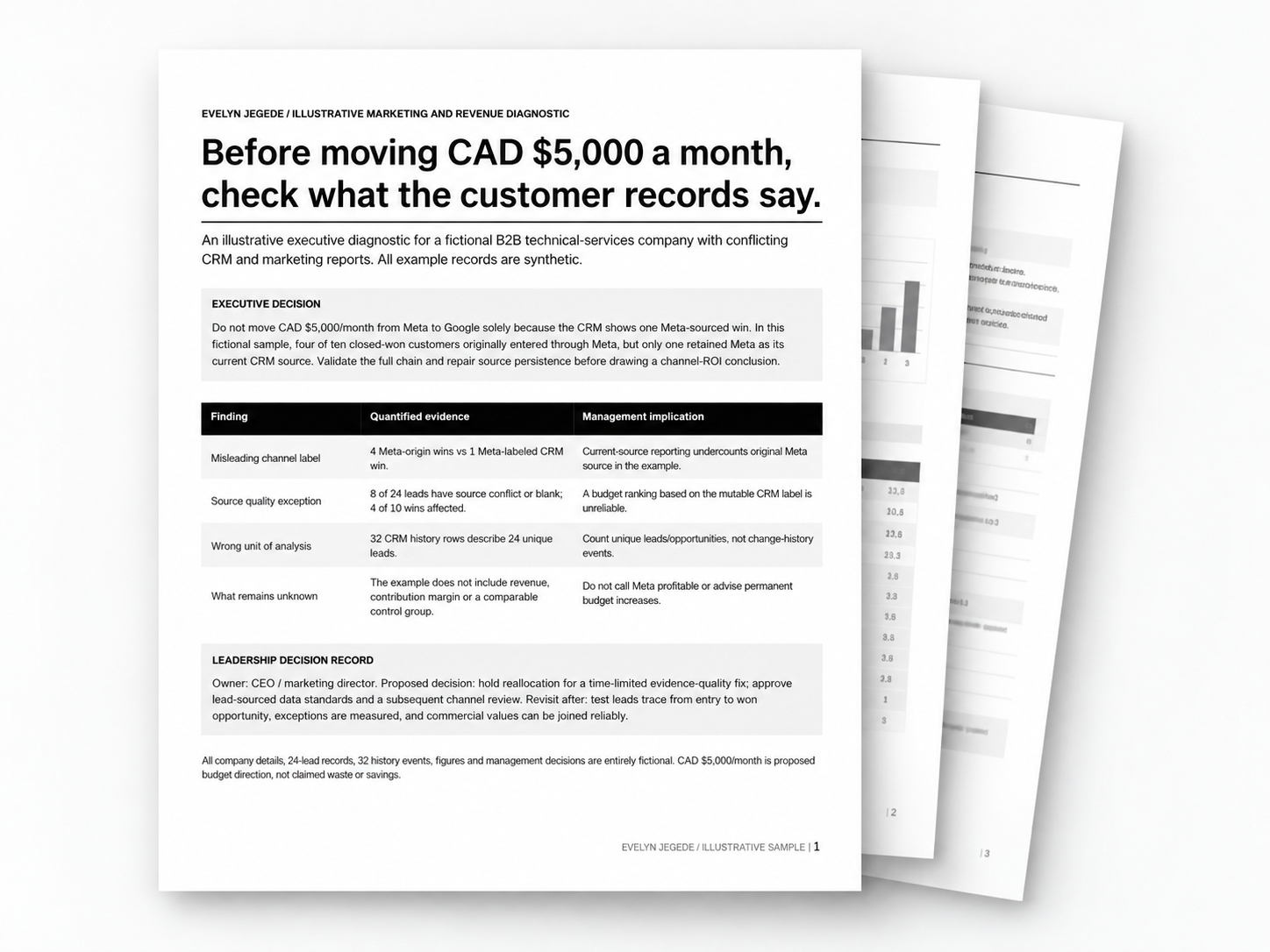
Imagine reviewing a company's marketing performance and finding that its CRM reports fewer customers from a particular channel than its historical records suggest.
Is marketing being undervalued? Were records updated? Is the reporting incomplete? And what can the available evidence actually establish?
This illustrative diagnostic examines those questions using synthetic marketing and CRM records.
Out of ten recorded wins in a fully synthetic dataset containing 24 unique leads and 32 historical CRM events.
The difference illustrates how relying only on a customer's latest recorded source can obscure earlier marketing interactions.
It doesn't prove Meta advertising caused those sales. It demonstrates why understanding how records change over time matters when interpreting performance.
Examining individual records to investigate reporting discrepancies.
Distinguishing verified findings from assumptions and evidence limitations.
Turning measurement gaps into prioritized tracking, reporting and workflow recommendations.
Start with the business question, understand the context and examine the available information.
Compare opportunities, investigate discrepancies, challenge assumptions and acknowledge what the evidence cannot establish.
Identify which findings matter most to the business decision and where resources should be focused.
Turn the analysis into practical actions, responsibilities and a sequenced roadmap.
Your business will have its own challenges, customers, systems and constraints. The assessment should reflect those realities rather than follow a predetermined answer.
The examples show how I approach two different commercial challenges. Your business has its own customers, systems, constraints and decisions to make.
Perhaps you're unsure which customers represent your next growth opportunity. Or perhaps you're investing in marketing but can't confidently connect that activity to paying customers.
Either way, the starting point is understanding the decision you're trying to make and the evidence needed to make it.

Tell me about the challenge you're facing and the business decision you're trying to make.